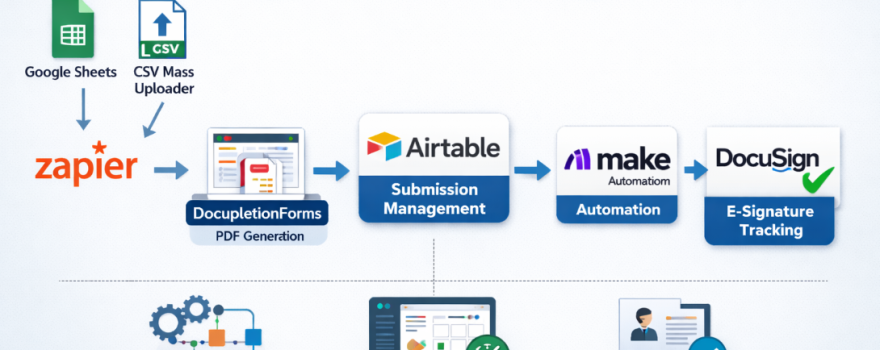
Google Sheets (or CSV uploader), Zapier, DocupletionForms Data-Merge PDF, AirTable, Make, DocuSign!

The DocupletionForms Integration Architecture outlines a structured, end-to-end workflow that connects Google Sheets, Zapier, DocupletionForms, Airtable, Make.com, and DocuSign into a unified document automation system. A submission can originate either from a new Google Sheets row (triggered via Zapier) or from the built-in CSV Mass Uploader inside DocupletionForms for batch processing. Once triggered, DocupletionForms performs conditional logic processing and PDF data-merging, generating structured document outputs ready for signature workflows.

From there, Airtable serves as the orchestration hub and state-management engine. Every submission is logged, scheduled, batched, and tracked using controlled status fields that prevent automation conflicts. Airtable determines when a submission is ready for downstream processing and securely triggers Make.com, which acts as the execution engine for document finalization and DocuSign envelope creation. This architecture ensures precise timing control, audit visibility, and scalable workflow coordination across multiple systems.

Make.com then monitors the DocuSign signing process and feeds real-time status updates back into Airtable, where operational dashboards and client portals reflect completion progress. The result is a scalable integration framework that supports single submissions or bulk client uploads while maintaining full audit traceability and workflow integrity. You can download the complete architectural breakdown here:

DocupletionForms Integration Architecture (PDF)

DocupletionForms Zapier Integration V1.4 Update COMPLETE!


DocupletionForms Zapier Integration – Version 1.4

Officially Promoted on Zapier

Version 1.4 is now live and publicly approved by Zapier.
After full draft testing, the integration has been successfully promoted and is production-ready.

What Version 1.4 Enables

With DocupletionForms v1.4, you can:

  • Send data from any Zapier-supported application
  • Map that data to a DocupletionForms form
  • Automatically merge the data into one or multiple PDF documents
  • Deliver the generated PDF via email or downstream Zapier automation
Automation Flow:
Any App → Zapier → DocupletionForms → Data-Merged PDF → Anywhere

How the Workflow Works

Example: Google Sheets → Automated PDF

  1. A new row is added in Google Sheets
  2. Zapier triggers
  3. Zap sends the sheet data to DocupletionForms
  4. Form fields are mapped to incoming data
  5. Internal Data-Merge maps form fields to PDF fields
  6. PDF is generated automatically
  7. The PDF is emailed or sent through additional Zap steps

The original data can also continue downstream in Zapier.

Core Value Proposition

Middleware Integration-as-a-Service

Instead of building custom PDF engines or backend automation pipelines, you simply:

  • Map fields
  • Configure merge settings
  • Connect through Zapier
  • Automate document output

No custom code required.

Why This Is Powerful

Most automation tools move data. Few can:

  • Convert structured data into properly formatted PDFs
  • Support internal conditional logic
  • Handle multi-document merges
  • Distribute documents through multiple delivery paths

Version 1.4 delivers stable, production-ready PDF automation inside Zapier.

Ideal Use Cases

  • Legal document automation
  • Contract generation workflows
  • Government or nonprofit form processing
  • SaaS platforms needing PDF generation
  • HR onboarding packets
  • Insurance documentation
  • Real estate contracts
  • Compliance or structured documentation pipelines

What’s New in v1.4

  • Officially promoted to Public by Zapier
  • Improved stability after draft testing
  • Enhanced data handling in Zap-based submissions
  • Reliable downstream Zap continuation
  • Production-ready PDF merge workflows

Architecture Overview

External App

Zapier Trigger

DocupletionForms Form Submission

Internal Field Mapping

PDF Data-Merge Engine

Email or Zapier Output

Reliability & Approval

Version 1.4 has been:

  • Fully tested in draft mode
  • Approved and promoted by Zapier
  • Verified for public production use

Get Started

  1. Create a Zap
  2. Select your trigger app
  3. Choose DocupletionForms
  4. Map your fields
  5. Configure your PDF merge
  6. Test and activate

You now have fully automated document generation.


How to Turn a Fillable PDF into a Question-Based Intake Form

How to Use a PDF Intake Encoding SOP to Turn Any Fillable PDF into a Question-Based Workflow

Fillable PDFs are everywhere in professional work. Law firms, accountants, consultants,
schools, nonprofits, and businesses all rely on them to collect information from clients,
staff, or the public. Yet despite being “fillable,” most PDFs are still difficult to use
efficiently.

People type into the wrong boxes. Important fields are missed. The same information is
entered multiple times. And when PDFs are handed off to others, there is rarely a clear,
repeatable process for turning those documents into structured, question-based forms.

This is exactly the problem the PDF Intake Question Encoding SOP is designed
to solve.

This article explains what the SOP is, what it allows you to do, and how people can use it
to reliably create questions that correctly fill out the fields of any uploaded fillable PDF.


What Is the PDF Intake Question Encoding SOP?

The PDF Intake Question Encoding SOP is a short, printable instruction document. Its sole
purpose is to explain how to create questions that correctly populate a fillable PDF.

It is not software. It is not a technical manual. It does not require programming knowledge.
Instead, it acts as a clear set of rules and steps that can be followed by:

  • Staff members
  • Encoders or form builders
  • Consultants
  • Clients
  • Or even AI assistants

When the SOP is uploaded into an AI Chat like ChatGPT alongside a fillable PDF, it provides all the guidance needed to
determine:

  • What questions should be asked
  • What each question should say
  • What type of answer each question should collect
  • Which PDF field each answer should fill

In other words, it turns a static document into a structured intake process.


The Core Problem with Fillable PDFs

Although fillable PDFs look simple on the surface, they hide several challenges:

  • Field labels are often unclear or inconsistent
  • Some fields look similar but serve different purposes
  • Users don’t know what information belongs in which box
  • Different people interpret the same PDF differently

This leads to errors, back-and-forth communication, and wasted time.

The SOP solves this by shifting the focus away from “filling boxes” and toward
asking the right questions.


The Key Principle: Questions Collect Meaning

The SOP is built around one simple idea:

Questions collect meaning. PDF fields receive meaning. Mapping connects the two.

A question is written to capture a specific piece of information. A PDF field is simply a
destination where that information should appear. The SOP teaches users how to connect those
two things correctly and consistently.


How the SOP Is Used in Practice

Using the SOP follows a straightforward process.

Step 1: Upload the Fillable PDF

Start by uploading the fillable PDF you want to work with. This could be a client intake form,
an application, a disclosure, or any other document with fillable fields.

Step 2: Review the PDF Visually

Open the PDF and read it carefully:

  • Go from top to bottom
  • Move left to right
  • Identify every box that expects information

This step ensures that no field is overlooked.

Step 3: Identify the PDF Field Names

Every fillable box in a PDF has a field name. These names are what determine where answers
will appear in the document.

The SOP instructs users to rely on the field names exactly as they are shown when mapping
answers to the PDF.

Examples of field names include:

  • LAST NAME
  • DATE OF BIRTH
  • CURRENT RESIDENTIAL ADDRESS

These names are treated as authoritative.


Writing Questions That Match the PDF

Once the PDF fields are identified, the next step is to write questions that match them
by meaning.

The SOP makes an important distinction:

  • The wording of the question does not need to match the field name
  • The meaning of the question must match exactly

For example:

PDF Field Name: DATE OF BIRTH

Question: What is the client’s date of birth?

Different wording, same meaning.


Choosing the Right Question Type

The SOP also explains how to choose the appropriate type of question based on the kind of
information being collected.

  • Short text for names and identifiers
  • Paragraph text for explanations or descriptions
  • Phone fields for phone numbers
  • Email fields for email addresses

This improves usability while keeping the PDF output correct.


Adding Help Text to Reduce Errors

Help text is optional, but strongly recommended.

The SOP encourages adding brief instructions beneath each question to explain:

  • Formatting expectations
  • What information is required
  • What to include or exclude

This reduces mistakes and follow-up questions.


Verifying That the PDF Fills Correctly

The final step is verification.

  1. Enter sample answers
  2. Generate the completed PDF
  3. Confirm each answer appears in the correct box

If something appears in the wrong place, the mapping is adjusted until it is correct.


Why This SOP Is So Powerful

The PDF Intake Question Encoding SOP creates consistency.

Instead of each person inventing their own way of “figuring out” a PDF, everyone follows
the same clear process. This makes it possible to:

  • Train staff quickly
  • Delegate encoding work confidently
  • Reuse the process across many PDFs
  • Reduce errors and rework

Most importantly, it transforms PDFs from static documents into reliable, structured workflows.


Who This Is For

This SOP is useful for anyone who regularly works with fillable PDFs, including:

  • Professional service firms
  • Administrative teams
  • Consultants and implementers
  • Organizations onboarding new clients
  • Anyone responsible for document intake

Final Takeaway

Fillable PDFs don’t have to be confusing or inconsistent.

With the PDF Intake Question Encoding SOP, you can clearly explain how to turn any PDF into
a set of well-written questions that reliably fill the correct fields every time.

Upload the SOP. Upload the PDF. Follow the steps. The rest takes care of itself.

Docupletion Forms & Retainer Crypto: Fed RAMP-first Security Convergence

Introduction: Building Forward From First Principles

Modern fintech, crypto, and SaaS failures have rarely been caused by broken cryptography. Instead, they arise from fractured governance, human-layer vulnerabilities, and systems that were never designed to operate under true adversarial pressure. DocupletionForms and RetainerCrypto.online are being built with a different philosophy: security is not a feature to be added later, but the organizing principle from the first line of code. This article explains our intent to mature DocupletionForms toward SOC 2, HIPAA, and FedRAMP-aligned controls, and to extend those same controls incrementally into RetainerCrypto.online as it is built in stages.

Why FedRAMP, HIPAA, and SOC 2 Together

Each compliance framework addresses a different failure mode that has repeatedly harmed crypto and SaaS platforms. Rather than choosing one, we treat them as overlapping lenses that reinforce each other.

  • SOC 2 emphasizes internal controls, change management, and auditability
  • HIPAA enforces strict handling of sensitive data, identity, and access boundaries
  • FedRAMP focuses on continuous monitoring, least privilege, and operational resilience

Together, they form a governance stack that prioritizes accountability over obscurity and resilience over marketing claims.

DocupletionForms as the Security Anchor Platform

DocupletionForms is not merely a form builder. It is designed as a structured intake, workflow, and policy-enforcement layer that sits between users, professionals, and downstream systems. Because it handles sensitive legal, financial, and potentially medical-adjacent data, it is the natural foundation for a compliance-first architecture.

  • Structured data intake with explicit data classification boundaries
  • Conditional logic enforcing role-based visibility and access
  • Immutable logs for all submissions, changes, and approvals

By hardening DocupletionForms first, we establish a trusted control plane that future systems can inherit from rather than reinvent.

Security as Workflow, Not Just Infrastructure

Many platforms focus on perimeter defenses while leaving workflows vulnerable. Our approach treats workflows themselves as security-critical assets.

  • Every action is tied to an authenticated identity
  • Every workflow step has defined authority and limits
  • Every exception is logged, reviewable, and reversible

This design directly addresses the class of failures seen in major exchanges where legitimate internal tools were abused by compromised users.

Incremental FedRAMP Alignment Instead of Big-Bang Certification

FedRAMP certification is expensive and time-consuming, but its control framework is still invaluable even before formal authorization. We are intentionally designing DocupletionForms and RetainerCrypto.online to align with FedRAMP controls incrementally.

  • Least-privilege access enforced from the earliest prototypes
  • Separation of duties across support, development, and operations
  • Continuous logging and monitoring as default, not add-ons

This allows us to grow into higher assurance environments without architectural rewrites.

RetainerCrypto.online: Built Bit by Bit, Not All at Once

RetainerCrypto.online will not launch as a monolithic crypto platform. It will be constructed in discrete, auditable components that inherit security properties from DocupletionForms.

  • Initial modules focused on non-custodial coordination and recordkeeping
  • Progressive introduction of lending, vaulting, and milestone payments
  • Explicit threat modeling for each new capability before release

This staged approach prevents the accumulation of hidden systemic risk.

Non-Custodial Design as a Security Control

Custody is the single greatest risk multiplier in crypto. Wherever possible, RetainerCrypto.online is designed to avoid custody entirely.

  • Multi-signature coordination rather than pooled asset control
  • User-retained keys with platform-mediated policy enforcement
  • No single hot wallet acting as a honeypot

This aligns naturally with FedRAMP’s emphasis on minimizing blast radius and single points of failure.

Identity and Access Management as the Core Control Plane

Identity failures, not cryptographic failures, dominate breach statistics. Our systems treat IAM as the primary security boundary.

  • Strong authentication with contextual risk evaluation
  • Role-based and attribute-based access controls
  • Just-in-time permissions with automatic expiration

This approach directly addresses the social engineering and insider misuse vectors that have compromised otherwise secure platforms.

Policy as Code and Machine-Enforced Governance

Human-enforced policies are fragile. We aim to encode governance directly into systems.

  • Automated enforcement of approval thresholds
  • Machine-validated compliance checks before execution
  • Blocked actions when policy conditions are not met

This reduces reliance on trust and increases reliability under stress.

Auditability as a First-Class Feature

Audit logs are often treated as a compliance afterthought. We treat them as an operational asset.

  • Immutable, append-only logging of critical actions
  • Clear attribution of who did what and why
  • Time-ordered reconstruction of incidents and decisions

This supports both internal governance and external regulatory review.

HIPAA-Informed Data Minimization and Segmentation

Even outside healthcare, HIPAA principles provide a strong model for data protection.

  • Minimum necessary data exposure by default
  • Strict segmentation between datasets and tenants
  • Clear lifecycle management for sensitive records

These controls reduce the impact of any single compromise.

Secure DevSecOps and Change Management

Most breaches exploit gaps between development and operations. Our model emphasizes disciplined change control.

  • Version-controlled infrastructure and configuration
  • Peer review and approval for production changes
  • Rollback and recovery planning built into deployments

This mirrors mature enterprise and government security practices.

Continuous Monitoring Instead of Periodic Audits

Security is a process, not a snapshot.

  • Real-time alerting on anomalous behavior
  • Correlation across application, infrastructure, and identity layers
  • Regular review of access patterns and permissions

This aligns directly with FedRAMP’s continuous monitoring philosophy.

Incident Response as a Designed Capability

Assuming compromise is not pessimism; it is realism.

  • Predefined response playbooks for common failure modes
  • Clear authority for containment and remediation actions
  • Post-incident review feeding back into controls

This reduces chaos and damage when incidents occur.

Crypto Transparency Without Security Theater

Public blockchains are transparent by design. We embrace this rather than attempting to hide it.

  • Assuming ABI visibility and adversarial code review
  • Designing contracts with explicit trust boundaries
  • Relying on governance and approvals, not secrecy

This reflects the reality that obscurity does not scale.

Convergence of Physical, Cyber, and Organizational Security

Security failures often cross domains. Our architecture assumes convergence.

  • Physical security considerations for infrastructure and hardware
  • Cyber controls integrated with operational workflows
  • Organizational roles aligned with technical authority

This reduces blind spots between teams and systems.

Why This Matters for Users and Partners

Users do not need to understand every control to benefit from them. What matters is trust grounded in structure.

  • Reduced risk of catastrophic loss
  • Clear accountability and transparency
  • A platform designed to endure regulatory scrutiny

This is especially critical for legal, financial, and mission-driven use cases.

A Long-Term Security Posture, Not a Marketing Claim

We are not claiming instant compliance or perfection. We are committing to a trajectory.

  • Security-first design decisions from day one
  • Incremental hardening rather than rushed expansion
  • Alignment with the highest assurance environments over time

This approach trades short-term hype for long-term credibility.

Conclusion: Building for Adversarial Reality

DocupletionForms and RetainerCrypto.online are being built for a world where attackers are patient, insiders can be compromised, and systems are always under scrutiny. By grounding our architecture in SOC 2, HIPAA, and FedRAMP principles from the beginning, and by extending those principles carefully into crypto-native systems, we aim to avoid the failure modes that have repeatedly harmed users and institutions alike. Security is not a destination; it is the discipline that makes everything else possible.

Enterprise Subscription Orgainization Roles!

This is where the Organization roles for the $297 enterprise subscription are set for each subscription:
These are the Organization roles for the $297 enterprise subscription:
1. Owner: The one who pays the subscription. Has access to all:
– Manage subscription
– Configure organization
– Manage members
– Manage forms
– Manage entries
– Manage templates
– Manage themes
– Access add-ons
2. Administrator:
– Manage members
– Manage forms
– Manage entries
– Manage templates
– Manage themes
– Access add-ons
3. Designer:
– Manage forms
– Manage entries
– Manage templates
– Manage themes
– Access add-ons
4. Editor:
– View, configure, and publish forms
– Manage entries
– Manage templates
– Manage themes
5. Viewer:
– View forms
– Manage entries
6. Learning Editor:
– Manage Own Forms
– Manage Own Templates
– Manage Own Themes
7. Learning Viewer:
– Manage Own Forms
So, Owners and Administrators can assign user roles to the Organization members to grant access: admin, designer, editor, learning accounts.
Note: When the owner/admin deletes a member, the member is not deleted from the system. The only thing that is deleted is the member access to the organization. Allowing the owner to re-invite the same user to the organization without any problem.

Updated Legal Policy!

We have updated our Legal Policy and it now includes information on different Countries with limitations as Countries on “Expert Law Systems” due to tighter regulations about the technology being their Country’s pattern of “Unauthorized Practice of Law”.

The issue is dealt with by the disclaimers in the Legal Policy and also by the limitation in those Countries to internal use only.

🔟 Key Reasons for Our Updated Legal Use Policy

  1. Clarifying Our Legal Role
    We want to be crystal clear: DocupletionForms.com is not a law firm and does not provide legal advice—this protects both us and our users from misunderstandings or misuse.
  2. Preventing Unauthorized Legal Practice
    To avoid regulatory issues, we’ve explicitly prohibited the use of our platform to simulate or offer legal advice where users aren’t licensed to do so.
  3. Adapting to International Law
    Some countries (like the Philippines, Germany, and France) restrict the use of expert legal systems by non-lawyers, so we’ve added jurisdictional disclaimers to stay compliant.
  4. Supporting Licensed Professionals
    We now define how licensed attorneys and authorized paralegals can use the platform legally, giving them clear guidance while enabling proper use.
  5. Creating Clear User Agreements
    We’ve added a new clause all users must agree to—acknowledging that they are responsible for following local laws when using our platform.
  6. Enabling Internal Use Licensing
    Businesses can now license DocupletionForms specifically for internal document workflows, like HR or compliance, with clear boundaries.
  7. Preventing Improper Resale
    We’ve restricted the resale or repackaging of the platform for public legal services without authorization, helping us protect our brand and mission.
  8. Protecting Against Legal Liability
    These updates reduce the risk of legal exposure for both our company and users by setting firm boundaries on use in high-risk jurisdictions.
  9. Anticipating Platform Growth
    As we expand globally and integrate with platforms like Salesforce, Jotform, Zapier, and tray.ai, clear use policies help streamline enterprise compliance.
  10. Building Long-Term Trust
    Transparency is the foundation of trust. These policy updates show that we’re serious about data integrity, legal boundaries, and supporting responsible innovation.

Please read the Legal Policy at https://docupletionforms.com/privacy-etc

PraxisProfessional.com can incorporate any type of researcher’s focus.

PraxisProfessional.com is geared to use volunteers who are focused on different types of disciplines and incorporate their desired research focuses into their overall work being done to help sex-trafficking victims.  The dual purpose with respect to DocupletionForms.com is to also give subscribers who seek to hone their skills in document process encoding an opportunity to create intake forms that route data.

Rebuilding lives after escaping the clutches of sex trafficking is a journey filled with resilience, courage, and the triumphant spirit of survivors. It’s a testament to the human capacity for healing and finding hope in the aftermath of profound adversity. With an estimated 25 million people affected by human trafficking globally, many of whom have been forced into the sex trade, the challenge is not only to free them but also to support them as they navigate the complex process of reintegrating into society. This journey, while daunting, is illuminated by the strength and determination of survivors and the communities ready to welcome them with open arms.

Checking PDF Checkboxes via Multiple Conditions!

THIS IS HUGE!  Checkboxes have been historically difficult!  Our new release inside of DocupletionForms.com is the ability to check multiple checkboxes at one time with one condition and/or any multiple set of conditions or group of conditions paired with other group conditions.  You can also set the minimum and/or maximum number of checkboxes that will be checked inside of the PDF from the FormBuilder itself.  This is a simple release note and we are going to be working on more instructions and examples.  The way it did function inside of DocupletionForms.com was that you could only use the checkbox utility in the form and it would only check one checkbox at a time.  Now you can trigger a checkbox to be checked in a PDF by any combination of conditions that a form submission presents.  It is possible from time to time that the PDF you are attmepting to automate will not allow inputs from outside programs via embedded programming in their meta data.  This is an issue no matter what and you have to become a PDF expert and flatten the PDF and then make your own fill-in-the-blanks, which is outside the scope of our program.  We work on California Judicial Council Forms and they tend to be the most difficult types of documents in general across all industries, but as such, any other PDF Document tends to be much easier to automate!

Simplifying Document Automation: How DocupletionForms.com Offers Powerful, No-Code Tools for Your Workflow

If you’re looking for a streamlined way to create and manage documents without needing to write a single line of code, DocupletionForms.com offers a powerful alternative to other document automation platforms like Formstack Documents. Our platform is built for professionals, small businesses, and organizations that want to automate paperwork with ease and flexibility — without sacrificing control or customization.

No-Code Document Automation, Built for You

DocupletionForms.com makes it easy to create automated document workflows using simple, conditional logic forms. You don’t need programming skills or IT support. Whether you’re assembling client agreements, intake forms, contracts, or recurring business documents, our system lets you build smart workflows that auto-populate your PDF templates and deliver them in seconds.

Dynamic Templates with Conditional Logic

Our platform supports robust template logic that responds to user input. This means your documents can change dynamically — whether it’s showing or hiding entire sections, filling in variable data, or formatting content based on form responses. This flexibility allows you to deliver professional, accurate documents tailored to each individual or case.

Data Integration for Seamless Automation

DocupletionForms.com allows you to connect form data directly to pre-formatted PDF templates. You can pull in data from your users, clients, or staff via custom forms and generate fully filled documents instantly. This eliminates manual copy-paste work, reduces human error, and saves countless hours of admin time.

Secure and Professional Document Handling

Security and professionalism are baked into every part of DocupletionForms.com. Documents are generated on demand through secure workflows, ready for download, email, or storage. Whether you’re using the system internally or delivering documents to clients, the process is efficient and polished.

Perfect for Business, Legal, Education, and Nonprofits

From small firms to volunteer-based nonprofits, DocupletionForms.com is adaptable for any use case involving repeatable document tasks. Legal intake forms, employment packets, school enrollment paperwork, nonprofit agreements — our platform handles them all with speed and consistency.

Try It Today

If you’re seeking a cost-effective, powerful way to automate document creation and reduce paperwork stress, explore DocupletionForms.com. Whether you’re transitioning from spreadsheets and manual editing or comparing platforms like Formstack Documents, you’ll find that our solution offers the essential tools you need — without complexity or clutter.

Our open call to Conservative Colleges, Christian Colleges, Grad Schools, Professional Programs & Law Schools

Proposal for Partnership with Conservative and Christian Colleges, Grad Schools, Professional Programs & Law School 

Subject: Enhancing Student Learning and Advocacy through DocupletionForms.com & PraxisProfessional.com.

Dear Administrators, 

I am writing to propose a partnership between Conservative and Christian Colleges, Grad Schools, Professional Programs & Law Schools and DocupletionForms.com, a platform dedicated to advancing student proficiency in document processes and legal systems. Our mission aligns with Conservative & Christian School’s commitment to academic excellence and service, offering students practical skills and opportunities to engage in meaningful advocacy. 

Overview of DocupletionForms.com: 

  • Educational Platform: Provides hands-on experience in document automation and legal system navigation, preparing students for professional success. 
  • Advocacy Integration: Collaborates with Praxis Professional, a pro bono contract paralegal organization focused on supporting sex-trafficking victims through legal assistance and conservative Christian biblical counseling via activities on PraxisProfessional.com. 

Praxis Professional’s Mission: 

Praxis Professional coordinates volunteers to perform paralegal work and open-source intelligence (OSINT) to assist attorneys and private investigators in supporting sex-trafficking victims. The organization emphasizes guiding victims toward conservative Christian biblical counseling, addressing their needs within a traditional worldview. For a comprehensive overview, please refer to our mission brief: 

Theological Alignment: 

Our approach is rooted in a commitment to uphold traditional biblical teachings. We affirm the scriptural stance on human sexuality, referencing passages such as Leviticus 18:22 and 20:13, which delineate clear boundaries regarding same-sex relations. This perspective informs our support for conservative Christian biblical counseling, providing guidance aligned with historical Christian doctrine. 

Proposal Details: 

We propose offering Universities and Other Schools a subscription to DocupletionForms.com at $295 per month, granting faculty and students full access to our platform. This partnership will: 

  • Enhance Educational Outcomes: Equip students with essential skills in document processing and legal systems. 
  • Provide Service Opportunities: Enable students to volunteer in advocacy efforts for sex-trafficking victims, integrating faith and learning. 
  • Align with Institutional Values: Support the university’s mission to foster academic excellence and compassionate service within a framework of conservative Christian principles. 

I welcome the opportunity to discuss how this collaboration can enrich your programs and support your students’ development. Please let me know a convenient time for a meeting. 

Blessings, 

James Polk

James@DocupletionForms.com

(657) 234-2232


1 2 3 6