Google Sheets (or CSV uploader), Zapier, DocupletionForms Data-Merge PDF, AirTable, Make, DocuSign!
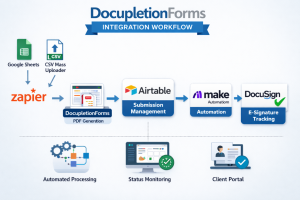
The DocupletionForms Integration Architecture outlines a structured, end-to-end workflow that connects Google Sheets, Zapier, DocupletionForms, Airtable, Make.com, and DocuSign into a unified document automation system. A submission can originate either from a new Google Sheets row (triggered via Zapier) or from the built-in CSV Mass Uploader inside DocupletionForms for batch processing. Once triggered, DocupletionForms performs conditional logic processing and PDF data-merging, generating structured document outputs ready for signature workflows.

From there, Airtable serves as the orchestration hub and state-management engine. Every submission is logged, scheduled, batched, and tracked using controlled status fields that prevent automation conflicts. Airtable determines when a submission is ready for downstream processing and securely triggers Make.com, which acts as the execution engine for document finalization and DocuSign envelope creation. This architecture ensures precise timing control, audit visibility, and scalable workflow coordination across multiple systems.

Make.com then monitors the DocuSign signing process and feeds real-time status updates back into Airtable, where operational dashboards and client portals reflect completion progress. The result is a scalable integration framework that supports single submissions or bulk client uploads while maintaining full audit traceability and workflow integrity. You can download the complete architectural breakdown here:

DocupletionForms Integration Architecture (PDF)
DocupletionForms Zapier Integration V1.4 Update COMPLETE!


DocupletionForms Zapier Integration – Version 1.4

Officially Promoted on Zapier

Version 1.4 is now live and publicly approved by Zapier.
After full draft testing, the integration has been successfully promoted and is production-ready.

What Version 1.4 Enables

With DocupletionForms v1.4, you can:

  • Send data from any Zapier-supported application
  • Map that data to a DocupletionForms form
  • Automatically merge the data into one or multiple PDF documents
  • Deliver the generated PDF via email or downstream Zapier automation
Automation Flow:
Any App → Zapier → DocupletionForms → Data-Merged PDF → Anywhere

How the Workflow Works

Example: Google Sheets → Automated PDF

  1. A new row is added in Google Sheets
  2. Zapier triggers
  3. Zap sends the sheet data to DocupletionForms
  4. Form fields are mapped to incoming data
  5. Internal Data-Merge maps form fields to PDF fields
  6. PDF is generated automatically
  7. The PDF is emailed or sent through additional Zap steps

The original data can also continue downstream in Zapier.

Core Value Proposition

Middleware Integration-as-a-Service

Instead of building custom PDF engines or backend automation pipelines, you simply:

  • Map fields
  • Configure merge settings
  • Connect through Zapier
  • Automate document output

No custom code required.

Why This Is Powerful

Most automation tools move data. Few can:

  • Convert structured data into properly formatted PDFs
  • Support internal conditional logic
  • Handle multi-document merges
  • Distribute documents through multiple delivery paths

Version 1.4 delivers stable, production-ready PDF automation inside Zapier.

Ideal Use Cases

  • Legal document automation
  • Contract generation workflows
  • Government or nonprofit form processing
  • SaaS platforms needing PDF generation
  • HR onboarding packets
  • Insurance documentation
  • Real estate contracts
  • Compliance or structured documentation pipelines

What’s New in v1.4

  • Officially promoted to Public by Zapier
  • Improved stability after draft testing
  • Enhanced data handling in Zap-based submissions
  • Reliable downstream Zap continuation
  • Production-ready PDF merge workflows

Architecture Overview

External App

Zapier Trigger

DocupletionForms Form Submission

Internal Field Mapping

PDF Data-Merge Engine

Email or Zapier Output

Reliability & Approval

Version 1.4 has been:

  • Fully tested in draft mode
  • Approved and promoted by Zapier
  • Verified for public production use

Get Started

  1. Create a Zap
  2. Select your trigger app
  3. Choose DocupletionForms
  4. Map your fields
  5. Configure your PDF merge
  6. Test and activate

You now have fully automated document generation.


formatting time in Zapier

The date time is sent as unix timestamp (integers). This solves the issue related to time zones between 3rd party servers. For example, this is the webhook data that is sent:
{
  “id”: 500,
  “form_id”: 125,
  “form_name”: “TEST Form”,
  “number”: 10,
  “ip”: “”,
  “created_at”: 1610484007,
  “updated_at”: 1610484007,
  “created_by”: 22,
  “updated_by”: 22,
  “status”: null,
  “new”: null,
  “answers”: {
    “Name”: “John”,
    “Email”: “john@example.com
  },
  “country”: “”,
  “city”: “”,
  “latitude”: “”,
  “longitude”: “”,
  “user_agent”: “Mozilla/5.0 (Windows NT 10.0; Win64; x64) AppleWebKit/537.36 (KHTML, like Gecko) Chrome/87.0.4280.141 Safari/537.36”,
}
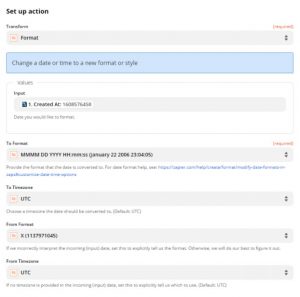
Then with Zapier you can use the Format action to convert the unix timestamp value to a date / time format, before send the value to the 3rd party app.
The above Format Step comes between the Trigger and the Action Steps in a Zap.

Conditional Webhooks!

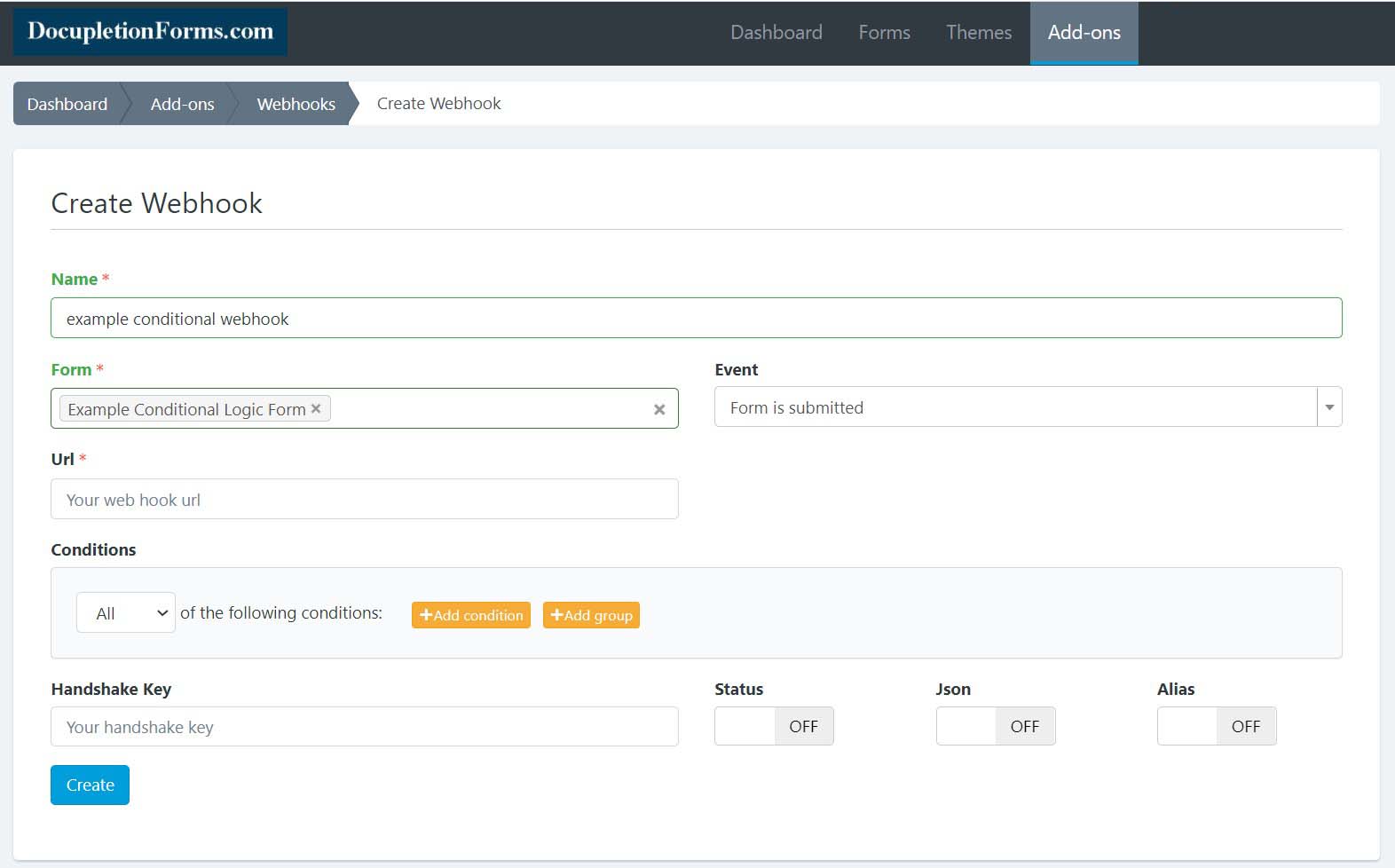
CONDITIONAL WEBHOOKS!

When somebody enters their information into your form, you can send CONDITIONAL WEBHOOKS to Zapier or anywhere else on the internet based on the conditions that you set.  Depending on how the people who submit your form answer your questions, different triggering webhooks will be sent to Zapier and Zapier will then trigger an action in any of the 2000+ programs as you determine in the Zap inside of your Zapier account.

  • You can ask people if they would like to also be added to your weekly email list when they leave you a contact form and if they click “yes” you can then send a CONDITIONAL WEBHOOK to Zapier to trigger the inclusion of a name and email in the email series program that you use.
  • You can send a CONDITIONAL WEBHOOK to FormStack Documents (formerly WebMerge) that will use the data entered into the form to automatically fill out a document.
  • You can add a contact in Clio.
  • You can add a Loop in DotLoop.
  • The list goes on.  There is no limit to the number of CONDITIONAL WEBHOOKS that you can send.

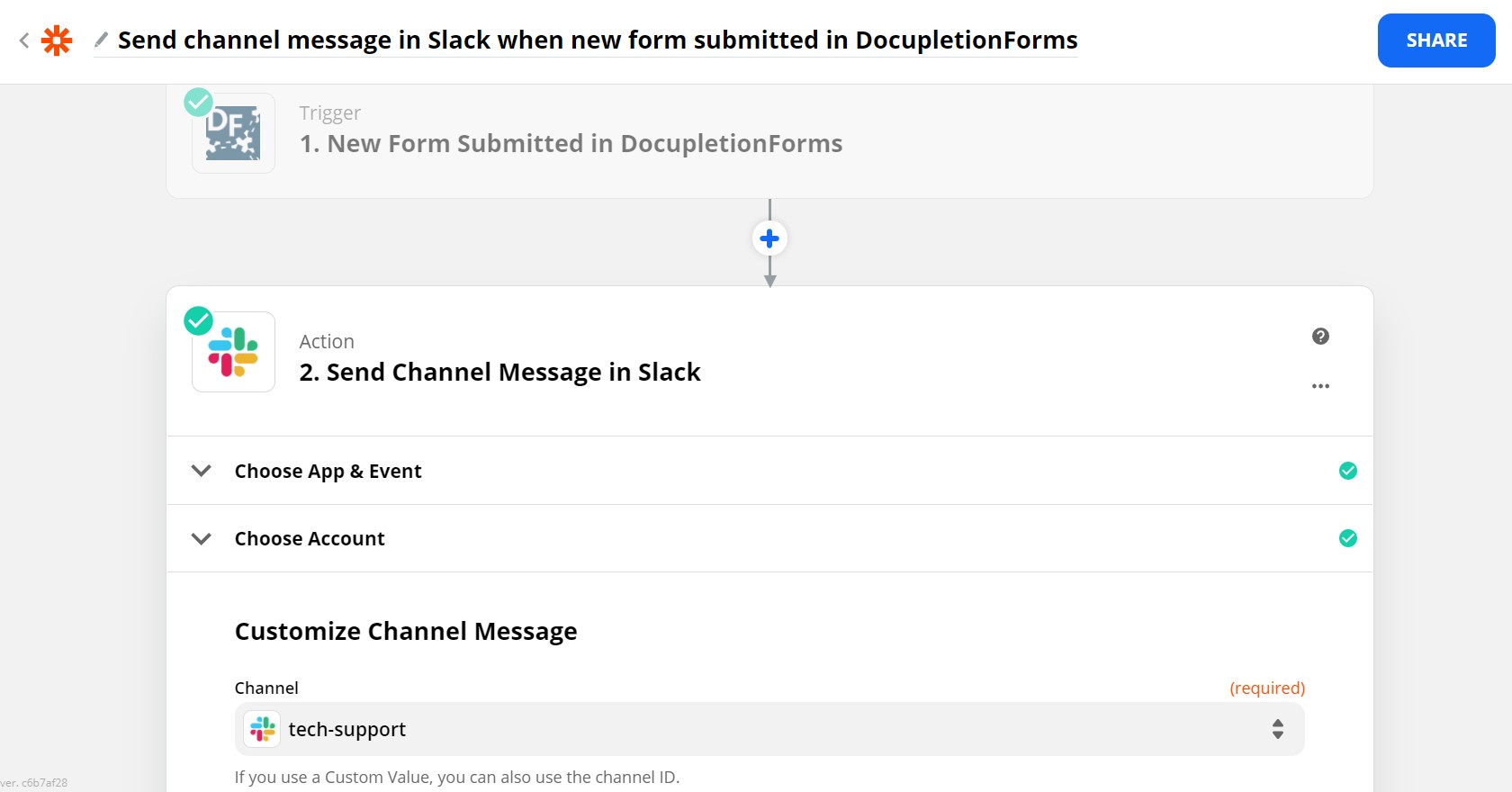
Zap from DocupletionForms to Slack via Zapier and make a channel message!

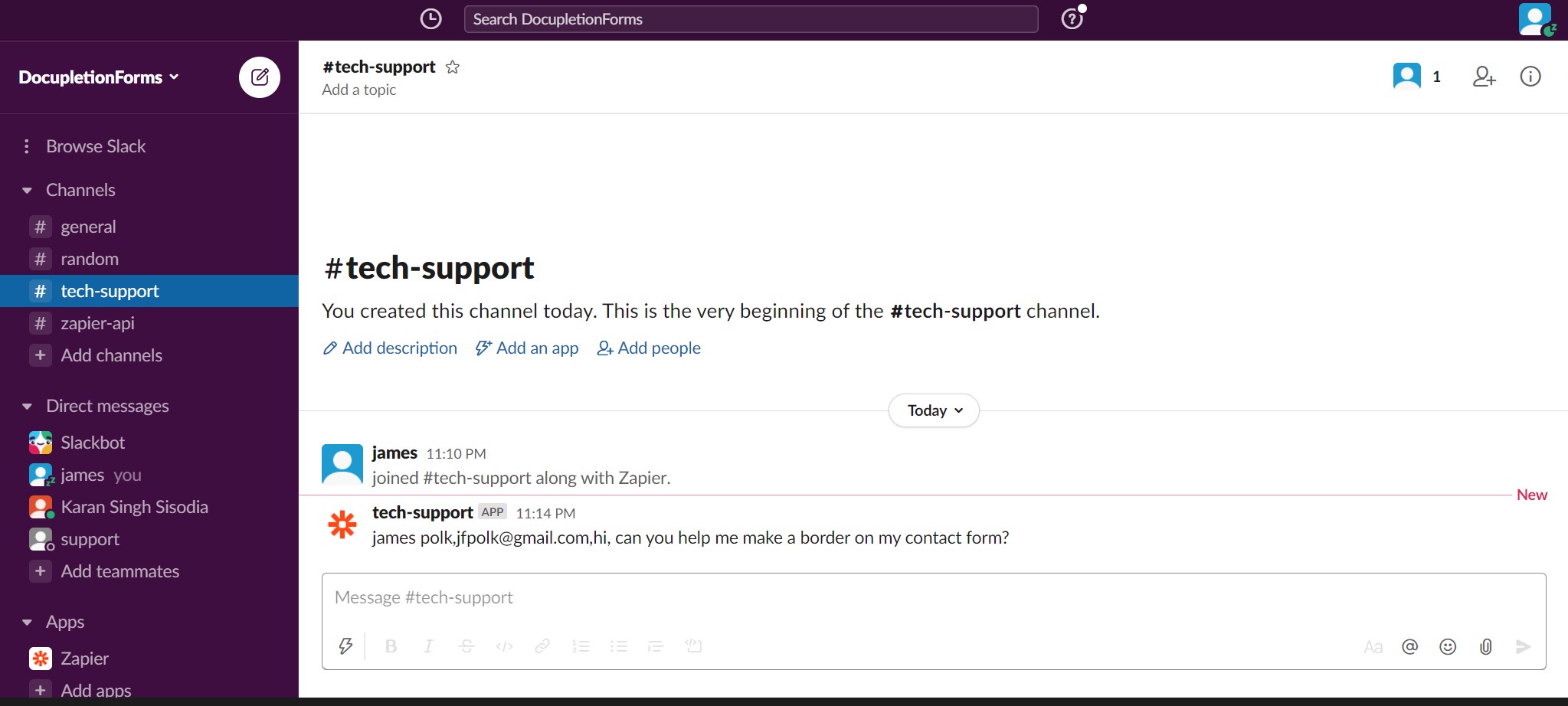
This is a really cool zap that will allow you to invite the people you want from your team to see the messages submitted via a specific contact form by zapping them to Slack via Zapier and using Slack to invite your Team Members!

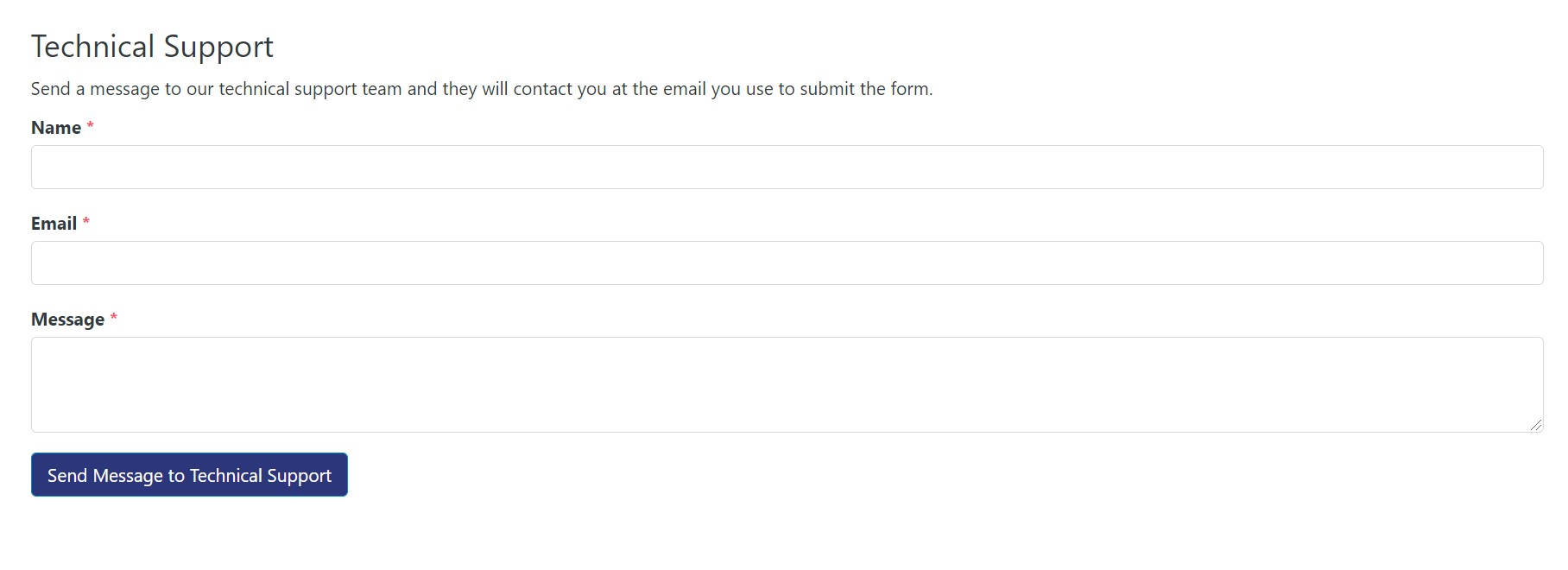
1. Make a contact form. 

2. Create a Slack Channel to send messages to.

3. Connect to Zapier.

4. Select your Contact Form in your Zapier.

5. Select your Slack and the Slack Channel.  

6. Boom!  The Zap is done and messages will appear in your Slack.

7. Invite the team members you want to be able to see that Slack Channel.