

What Is Deterministic Document Automation? The Secure Document Layer for Professional Workflows

By James Polk — Founder & COO, DocupletionForms  |  San Diego County LDA #139


Every serious company eventually needs one sentence that explains what it is really building.

Not just what the software does today. Not just what features are already visible on the website. Not just what a customer sees on the surface.

A real strategic sentence explains the larger category the company is trying to define.

For DocupletionForms, that sentence is this:

DocupletionForms is building the secure, deterministic document automation layer for professional workflows — selecting and completing the right documents from conditional logic, integrating with the platforms professionals already use, and growing through integrators, associations, and industry-specific partners.

That is the “huge” version of the company.

It means DocupletionForms is not merely a form builder. It is not merely a PDF filler. It is not merely an automation add-on. It is a professional document workflow layer designed for situations where the right data must produce the right document or set of documents every time.

In professional environments, documents are not casual content. They are business records, client records, legal records, compliance records, intake records, transaction records, authorization records, service records, and operational records. The problem is not simply collecting information. The harder problem is selecting the right documents, completing them correctly, routing them securely, and integrating them with the systems professionals already use.

That is where deterministic document automation becomes important.

Why Deterministic Document Automation Matters

The word “deterministic” matters because many professional workflows cannot depend on guesswork.

In a deterministic workflow, the same inputs produce the same outputs according to defined rules. When a user answers a question a certain way, the system knows which document is required. When a client selects a certain type of service, the system knows which forms, notices, letters, agreements, or supporting documents belong in the packet.

That is very different from a vague automation process where someone fills out a form and then manually decides what to do next.

Professional document work often involves branching logic:

  • Which type of client is this?
  • Which service is being requested?
  • Which documents apply?
  • Which documents do not apply?
  • Which fields must be completed?
  • Which documents must be sent to the client?
  • Which documents must be retained internally?
  • Which documents must be sent to another platform?
  • Which documents must trigger a follow-up workflow?

A deterministic document automation platform exists to answer these questions with rules, structure, and repeatability.

That is especially important when a workflow may involve multiple documents, not just one document.

A single intake process may need to generate a cover letter, a client questionnaire, a service agreement, an authorization form, an internal checklist, and several conditional documents that depend on the client’s answers. The value of the system is not just that it completes a PDF. The value is that it selects and completes the correct document set.

That is the heart of what DocupletionForms does.

Why AI-Generated Documents Can Be Risky in Certain Workflows

Artificial intelligence is powerful, but not every document workflow should be driven by AI-generated output.

There are many situations where AI can help with summarization, drafting, research, classification, or user support. But when a professional workflow requires the correct document to be selected, completed, and preserved, a deterministic rules-based system may be safer and more appropriate.

The reason is simple: professional workflows often require predictable results.

If a document packet depends on client status, jurisdiction, service type, transaction type, risk category, or compliance requirement, the system cannot merely “suggest” an answer. It needs to follow defined logic.

AI-generated documents may introduce risks such as:

  • inconsistent wording
  • omitted fields
  • invented details
  • incorrect assumptions
  • unpredictable document selection
  • lack of repeatability
  • unclear auditability
  • difficulty proving why a document was generated

For some use cases, those risks may be manageable. For other workflows, they are unacceptable.

That is why deterministic document automation should not be seen as the opposite of AI. It should be seen as the structured layer that professional workflows need when correctness, repeatability, and security matter.

AI can assist around the edges. But the core selection and completion process for important documents should often remain rule-based, auditable, and predictable.

Why Rule-Based Document Selection Is Important

Many document automation tools focus on completing one document.

DocupletionForms is focused on the larger problem: selecting and completing the right documents based on the user’s answers and the business rules behind the workflow.

That distinction matters.

In real professional environments, the question is often not:

“What information goes into this document?”

The real question is:

“Which documents are required for this situation?”

A well-designed rule-based system can determine that automatically.

For example, a workflow may need to select documents based on:

  • client type
  • case type
  • transaction type
  • service category
  • location
  • risk level
  • requested outcome
  • prior answers
  • required supporting documents
  • professional review steps
  • integration triggers

This is where conditional logic becomes more than a convenience feature. It becomes the decision structure behind the document workflow.

The better the logic, the more useful the automation becomes.

Instead of making a professional manually decide which documents apply, DocupletionForms can help turn those decisions into structured rules. That means fewer missed documents, fewer repeated tasks, and more consistent workflows.

How Multi-Document Completion Works

Multi-document completion is one of the most important ideas behind the DocupletionForms platform.

A user may complete one intake process, but the result may be multiple completed documents.

This creates a powerful workflow pattern:

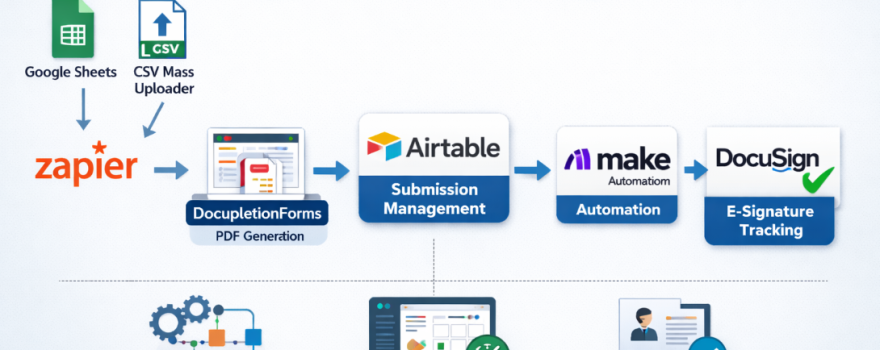
One guided intake → conditional logic → selected document set → completed documents → integrated delivery or storage.

That pattern can apply across many industries.

In a legal support workflow, one intake may generate client forms, declarations, letters, internal review documents, and supporting forms.

In a real estate transaction workflow, one intake may generate disclosure documents, transaction checklists, notices, and client communication documents.

In a process-serving workflow, one intake may generate service instructions, affidavits, proofs of service, and status documents.

In a nonprofit workflow, one intake may generate referral forms, consent forms, internal case notes, and follow-up documents.

In a business operations workflow, one intake may generate onboarding documents, authorization forms, service agreements, and compliance checklists.

This is why the platform is a document automation layer, not merely a form tool.

Forms collect data. DocupletionForms turns collected data into completed document workflows.

How Integrations Connect Intake to Completed Packets

Professional users already work inside existing systems. They use CRMs, case-management tools, spreadsheets, cloud storage, email platforms, payment systems, workflow tools, and industry-specific software.

A document automation platform becomes far more valuable when it integrates into those existing systems.

That is why integrations are central to the DocupletionForms strategy.

The goal is not to force every professional to abandon the tools they already use. The goal is to make DocupletionForms the document layer that connects to those tools.

That can include:

  • Zapier integrations
  • Salesforce integrations
  • webhook-based workflows
  • CRM connections
  • database-style record workflows
  • cloud storage workflows
  • email notifications
  • PDF generation and routing
  • e-signature connections
  • industry-specific platform integrations
  • direct API connections over time

The integrator’s role becomes critical here.

Many professionals know what their document process should accomplish, but they need someone technical enough to build the workflow. Integrators, consultants, automation agencies, and platform specialists are often the people closest to the real document problems inside an industry.

They understand the forms. They understand the data. They understand the platforms. They understand where the workflow breaks down.

That is why DocupletionForms grows with integrators, not around them.

How Industry-Specific Workflows Differ

Document automation becomes more valuable when it understands the differences between industries.

A law office does not think about documents the same way a real estate transaction coordinator does. A process server does not have the same workflow as a nonprofit intake coordinator. A tax preparer does not have the same document needs as an insurance claims professional.

The platform is general by design, but the messaging and workflow examples are industry-specific.

That is why DocupletionForms tailors content, workflows, and integrations to different professional lanes, such as:

  • legal support and law office workflows
  • process serving workflows
  • real estate transaction coordination
  • tax and accounting support
  • nonprofit intake and referral workflows
  • insurance and claims workflows
  • financial services and compliance workflows
  • healthcare-adjacent professional services
  • education, training, and association workflows

Each industry has its own document logic. Each industry has its own trust requirements. Each industry has its own integration environment. Each industry has its own associations, consultants, trainers, and professional influencers.

DocupletionForms is one document automation platform that supports many industry-specific document workflows.

Why Security Must Be Part of the Core Message

Professional document workflows often involve sensitive information.

That may include legal information, financial information, health-related information, client records, personally identifiable information, business records, victim-support information, transaction records, or confidential internal notes.

Because of that, security cannot be treated as a minor feature.

A serious professional document automation platform needs to be able to communicate clearly about:

  • secure data handling
  • access control
  • user permissions
  • encryption
  • auditability
  • secure integrations
  • webhook security
  • role-based workflows
  • data retention
  • incident response planning
  • compliance readiness
  • professional trust

A generic form tool may be enough for simple surveys. But professional document automation requires a higher trust standard.

That trust standard is part of the DocupletionForms brand.

The message should be clear:

When documents matter, security matters.

How Integrators Can Make Money Implementing Document Automation

Integrator partnerships are one of the most important growth channels for DocupletionForms.

Many businesses do not just need software. They need implementation.

They need someone to map the workflow, build the form, configure the conditional logic, connect the integrations, test the document outputs, and train the team.

That creates a strong opportunity for integrators.

A Zapier consultant can use DocupletionForms to add document generation to existing automations.

A Salesforce consultant can use DocupletionForms as a document layer for records, forms, and client packets.

A legal-tech consultant can help law offices build intake and document workflows.

A real estate transaction consultant can build document packets for transaction coordinators.

A nonprofit technology consultant can build secure intake and referral workflows.

An automation agency can offer document automation as a recurring service.

This is why the partner program is not a generic affiliate program. It is an integrator recruiting program with an affiliate layer attached.

The best partners are not merely people who can place a link. The best partners are people who can solve workflow problems for clients.

DocupletionForms gives those partners:

  • recurring commission opportunities
  • not-for-resale demo accounts
  • implementation guides
  • training materials
  • partner landing pages
  • workflow templates
  • security documentation
  • co-marketing materials
  • certification opportunities
  • industry-specific use cases

That is how a software platform becomes an ecosystem.

How Associations Can Help Members Modernize Document Processes

Professional associations are another major opportunity.

Many associations exist to help their members improve standards, reduce operational burdens, adopt better technology, and stay competitive. Document automation fits naturally into that mission.

An association partnership could help members understand:

  • how to reduce repetitive document preparation
  • how to standardize intake processes
  • how to create consistent document packets
  • how to use conditional logic to reduce errors
  • how to connect document workflows to existing systems
  • how to improve security in member workflows
  • how to train staff or students on modern document automation
  • how to work with certified integrators

This could apply to associations in legal support, real estate, process serving, tax preparation, nonprofit services, compliance, financial services, and professional education.

The association does not need to become a software company. It can help members modernize by introducing a structured document automation platform and a network of trained integrators.

This creates a three-sided growth model:

DocupletionForms provides the platform. Integrators implement the workflows. Associations introduce and educate the professional community.

That model is much bigger than selling one subscription at a time.

The Need for a Master Category Page: “Deterministic Document Automation”

This is the DocupletionForms master category page.

It does not merely describe the product. It defines the category.

This page answers:

  • What is deterministic document automation?
  • How is it different from generic form building?
  • How is it different from AI-generated document drafting?
  • Why does rule-based document selection matter?
  • How does multi-document completion work?
  • Why do professional workflows need predictable outputs?
  • How do integrations connect intake to completed document packets?
  • What industries benefit from deterministic document automation?
  • How can integrators build client workflows using the platform?
  • How can associations help members adopt document automation?

A master category page gives the market a clear explanation. It also gives publishers, affiliates, integrators, associations, and AI/search systems a consistent story to repeat.

That matters because category creation requires repetition.

DocupletionForms anchors the phrase “deterministic document automation” here — the central page that explains it more clearly than anyone else.

The Editorial and Media Engine

DocupletionForms publishes like a category creator.

That means content cannot be random. It needs to repeatedly explain the same core ideas from different angles, for different audiences, and across different channels.

The editorial program consistently explains:

  • why deterministic document automation matters
  • why AI-generated documents are risky for certain workflows
  • why rule-based document selection is important
  • how multi-document completion works
  • how integrations connect intake to completed packets
  • how industry-specific workflows differ
  • how integrators can make money implementing document automation
  • how associations can help members modernize document processes

This is not just traditional blogging. It is category-building.

Every article helps the market understand why DocupletionForms exists.

A strong editorial engine could include:

  • category pages
  • industry pages
  • partner pages
  • integration pages
  • comparison pages
  • security pages
  • workflow diagrams
  • implementation guides
  • use-case articles
  • case studies
  • partner interviews
  • association-focused articles
  • LinkedIn posts
  • newsletter content
  • video explainers
  • webinar scripts
  • publisher pitches

The goal is to make the same strategic idea visible everywhere:

Professional document workflows need secure, deterministic automation that can select and complete the right documents, connect with existing platforms, and be implemented by trained integrators.

Why Publishers, Affiliates, and Media Partners Matter

Once the story is clear, outside partners can amplify it.

Publishers can write about the category.

Affiliates can explain the product to niche audiences.

Integrators can demonstrate real workflows.

Associations can educate their members.

Media partners can help create visibility beyond DocupletionForms’ own website.

But the story has to come first.

If the company’s message is unclear, outside partners will repeat an unclear message. If the company’s message is strong, outside partners can help make that message visible across the web.

That is why the internal editorial strategy matters before a large media campaign.

DocupletionForms needs to create the clearest possible explanation of deterministic document automation, multi-document completion, secure integrations, and partner-led implementation. Then publishers, affiliates, integrators, and associations can help distribute that message.

The future of visibility will not depend only on one website ranking for one keyword. It will depend on consistent, credible mentions across many sources, platforms, and professional communities.

That is why DocupletionForms builds its own editorial foundation first, then uses partners to expand it.

The Huge Version of DocupletionForms

The huge version of DocupletionForms is not just a SaaS subscription business.

It is a professional document automation ecosystem.

The platform selects and completes documents.

The integrations connect workflows.

The security layer creates trust.

The integrators implement solutions.

The associations educate members.

The publishers and affiliates amplify the category.

The industry pages explain the use cases.

The master category page defines the market.

That is how DocupletionForms can grow from a product into a platform, and from a platform into a category.

The strategic sentence is the starting point:

DocupletionForms is building the secure, deterministic document automation layer for professional workflows — selecting and completing the right documents from conditional logic, integrating with the platforms professionals already use, and growing through integrators, associations, and industry-specific partners.

That is the big idea. Now the work is to make the market understand it, repeat it, trust it, and build on top of it.


Become a DocupletionForms Integration Partner

Put a deterministic document layer in the middle of your clients’ stacks, resell it instead of building it, and earn recurring affiliate revenue.

If you implement Salesforce, build Zapier automations, or run an SI or consulting shop, the document last mile is probably something you hand-build and then maintain forever. The partner program lets you resell a deterministic document layer instead: a missing puzzle piece you drop into stacks you’ve already sold, earning recurring affiliate revenue — without owning fragile merge logic or the support tickets it generates.

Who this is for

Salesforce consultants, Zapier and automation agencies, and SI or consulting shops that already connect their clients’ platforms and keep running into the same gap: getting the right documents out, reliably.

The three-part value

  • A missing puzzle piece. The document last mile, handled — resell it instead of building and maintaining it.
  • Recurring revenue. Every client you bring runs through the partner program, so it’s a recurring line, not a one-time setup fee.
  • Determinism means no support burden. Rule-based selection means the same inputs always yield the same documents — no variability tickets you have to own. That reliability is what lets you put your name behind the recommendation.

How partnering works

1

Apply. Tell us about your practice and the platforms you implement.
2

Get your link. You’re set up in the partner program with a tracking link.
3

Bring clients. Recommend the deterministic document layer into the stacks you already build.
4

Earn recurring. Commissions run on a recurring basis for the clients you bring.

Proof points

This isn’t a roadmap pitch — the integrations are live. Bidirectional webhooks, the Salesforce ISV connector, and Zapier multi-document merge are all shipping today. You’re reselling something that works now, not something that’s coming.

Apply to the partner program

Resell the document last mile to the clients you already serve — and earn recurring.

Apply now
Start a free trial

Frequently asked questions

Who can become a partner?

Salesforce consultants, automation and Zapier agencies, and SI or consulting shops who implement client stacks.

How do I get paid?

Recurring commissions through the partner program for the clients you bring.

Do I have to build or maintain the integration?

No. You resell a layer that’s already built, and determinism keeps the support burden off you.

What’s live today?

Bidirectional webhooks, the Salesforce ISV connector, and Zapier multi-document merge.

How do I start?

Apply through the partner page to get your link.

JP

James Polk — Founder & COO, DocupletionForms

James was formerly a San Diego County Legal Document Assistant and now builds deterministic, rule-based document automation for the professionals — and the integrators who serve them — who can’t afford to send the wrong document.

Specialist vs. Generalist: Why Conditional Multi-Document Selection Is Its Own Discipline

Generalist document tools do many things well. Conditional multi-document selection is the one thing we do completely — and it’s a discipline of its own.

If you’re comparing document-automation tools, the useful question isn’t which one does more — it’s whether you need a generalist or a specialist. Generalist tools cover a broad range of document tasks capably. DocupletionForms is built around one thing: conditional multi-document selection — choosing the correct set of documents by rule, deterministically. This is a positioning difference, not a scorecard.

Generalist vs. specialist — the honest frame

Generalist document tools are genuinely good at a wide span of jobs: single-template merges, e-sign flows, broad integrations. If you need a bit of everything, that breadth is the right call. A specialist makes a different bet — do one hard thing completely. Ours is conditional multi-document selection, and we treat it as the whole product rather than one feature in a list.

What conditional multi-document selection actually means

It’s the step where one intake has to become the correct set of documents — not one template filled, but many possible documents, with the right subset chosen by the particulars: outcome, type, jurisdiction. Doing that reliably means the same inputs always select the same set. It’s deceptively hard, which is exactly why it’s worth specializing in.

What generalist tools do well

Plenty. Broad template libraries, mature e-sign, large connector ecosystems, polished editors. If your need is a single document from a single trigger, a generalist will serve you well — and we’d tell you so. We’re not the everything tool, and we don’t pretend to be.

When the specialist is the right choice

  • One intake routinely explodes into many documents.
  • The correct subset depends on conditions — outcome, entity, jurisdiction.
  • A wrong or missing document carries real consequence.

When those are true, conditional multi-document selection is the core requirement — and a tool built entirely around it tends to behave differently, at scale, than one where the same workflow is one capability among many.

Determinism and focus, together

The two reinforce each other: specializing in conditional selection is what lets us make it deterministic, and determinism is what makes the specialty trustworthy. Same inputs, same set, every time — that’s the close.

See conditional selection in action

Try it on a real intake, or read how it works in a specific kind of work.

Start a free trial
Read a worked example

Frequently asked questions

Is DocupletionForms a FormStack Documents or WebMerge alternative?

It’s the specialist option. If conditional multi-document selection is your core need, we’re built entirely around that, where generalist tools treat it as one capability among many.

What’s the difference between single-template merge and conditional multi-document selection?

Single-template merge fills one document; conditional selection chooses the correct set of documents from many possibilities by rule.

Do generalist tools do this at all?

Many handle a range of document tasks well. The question for your project is whether conditional selection is central to the product or an add-on, and how it behaves once the rules and document count grow.

Why does determinism matter in a comparison?

Because for consequential documents, consistent output for consistent input is the property you’re actually buying.

JP

James Polk — Founder & COO, DocupletionForms

James was formerly a San Diego County Legal Document Assistant and now builds deterministic, rule-based document automation for the professionals — and the integrators who serve them — who can’t afford to send the wrong document.

Bidirectional Webhooks for Document Automation: Data In, Documents Out

When there’s no off-the-shelf connector, a webhook is the universal adapter: post data in, get finished documents and metadata back out.

Bidirectional webhooks are the integration pattern for any platform without a native connector: you POST data to an inbound endpoint, and finished documents plus structured metadata come back out to a destination you control. It’s the universal adapter that lets an agency wire DocupletionForms into any client stack — and because selection is deterministic, the same payload always returns the same documents.

The generic-webhook use case

Native connectors are great when they exist. When they don’t — a niche CRM, a custom app, an internal tool — a webhook is how you connect anyway. If a system can send an HTTP request and receive one, it can drive document generation.

Inbound: post data to a webhook

Your platform POSTs a JSON payload of the case or record fields to the inbound endpoint. DocupletionForms reads those fields, deterministically selects the document set, and merges the data in.

Outbound: documents and metadata back out

On completion, the outbound side sends the finished documents — or expiring URLs to them — plus metadata back to a destination you specify: your app, a storage location, or the next step in your pipeline.

The shape of it, end to end

1

POST the payload. Your system sends the record fields as JSON to the inbound endpoint.

2

Rules select and merge. DocupletionForms picks the document set by rule and merges the fields in — deterministically.

3

Receive the result. The outbound webhook returns the documents (or expiring links) and metadata to the destination you set.

Illustrative shape: in goes a record like matter type, party, and jurisdiction fields; out comes a list of finished documents with links and a completion status. The exact endpoint and field names live in the developer documentation — treat this as the pattern, not the contract.

Why this is the agency’s universal adapter

One pattern covers every client whose platform isn’t on a connector list. Build it once, reuse it across clients — the document last mile becomes a solved, reusable piece of your toolkit instead of a bespoke build each time.

Determinism note for developers who own support

Deterministic selection means the same payload always returns the same documents — which means reproducible behavior, testable outputs, and no “it picked differently this time” tickets. For whoever owns support, that predictability is the point.

Wire it into any stack

Read the developer docs, or partner to resell the pattern across your clients.

Read the developer docs
Become an integration partner

Frequently asked questions

When should I use webhooks instead of a connector?

When the platform has no native or Zapier connector, or when you want a direct, custom integration you fully control.

What comes back from the outbound webhook?

Finished documents — or expiring links to them — plus structured metadata about the run.

Is the output deterministic?

Yes. The same payload always returns the same document set, which makes the integration reproducible and testable.

Where are the exact endpoint and field details?

In the developer documentation, which carries the current endpoint, payload, and field specifics.

JP

James Polk — Founder & COO, DocupletionForms

James was formerly a San Diego County Legal Document Assistant and now builds deterministic, rule-based document automation for the professionals — and the integrators who serve them — who can’t afford to send the wrong document.

Why Document Selection Should Be Rule-Based, Not AI

For documents that carry consequence, deterministic selection isn’t a preference — it’s risk reduction. Here’s the honest case.

When a document can be legally or financially consequential, how it gets selected matters as much as what it says. Rule-based selection produces the same set for the same inputs, every time; a generative model, by design, cannot make that promise. For consequential documents, that difference is risk reduction, not a stylistic choice — and it’s the one claim an AI document tool genuinely can’t make.

What “set it and forget it” actually requires

The phrase only means something under one condition: identical inputs produce identical output, indefinitely. If the same intake can yield a different document set on different days, you haven’t automated the work — you’ve added a variable you now have to check. Reliability is the whole product.

Where AI introduces variance — and why that’s a problem here

Generative models are built to vary; that’s what makes them genuinely useful for drafting and ideation. But variance at the selection step — which documents belong in this packet — is exactly what you don’t want when a wrong or missing document is a rejected filing or a liability. The strength of the model in one context is the disqualifier in this one.

How rule-based selection works, in plain terms

You define the rules once: if these inputs, then these documents. The system evaluates the inputs and assembles the set. No interpretation, no improvisation — just the rules you set, applied consistently. The judgment lives in the rules, and in the professional who wrote them; the system only executes.

The honest competitive claim

This is the line worth being precise about: an AI document tool can’t promise identical output for identical input, because non-determinism is intrinsic to how it works. That isn’t a marketing jab — it’s a fact about the technology, and it’s why deterministic selection is the right foundation for consequential documents. We’re not claiming AI is bad. We’re claiming it’s the wrong tool for this specific job.

Tie it to liability, not features

The reason to care isn’t a product spec. It’s that the professional signs the work. When the same matter always produces the same correct set, the professional’s exposure goes down and their time goes up. That’s the actual value — determinism as risk reduction, not a feature on a list.

See determinism applied

Read how this plays out in a specific kind of work, or put it in your own stack.

Read a worked example
Become an integration partner

Frequently asked questions

Is rule-based document automation better than AI?

For documents that carry consequence, yes on the dimension that matters: it produces the same output for the same inputs, which a generative model can’t guarantee. For drafting and ideation, AI is a fine tool — different job.

Does deterministic mean inflexible?

No. The rules can be as nuanced as you need. “Deterministic” only means consistent, not simple.

Can’t an AI just be told to be consistent?

Not reliably. Non-determinism is intrinsic to how generative models produce output, so identical inputs can still yield different results.

What documents is this most important for?

Any where a wrong or missing document is a rejected filing, a compliance gap, or a liability.

JP

James Polk — Founder & COO, DocupletionForms

James was formerly a San Diego County Legal Document Assistant and now builds deterministic, rule-based document automation for the professionals — and the integrators who serve them — who can’t afford to send the wrong document.

Generate Documents from Salesforce Custom Objects — No Apex Required

Any Salesforce custom object can become a conditional, multi-document set — orchestrated through Zapier, with no Apex and no managed package.

You can generate a complete, conditional set of documents from a Salesforce custom object without writing a line of Apex or installing a managed package. The path runs custom object → Zapier → DocupletionForms → deterministic merge → finished files back into Salesforce. Most integrators don’t realize this is possible without custom development. It is — and this is the recipe.

The problem: custom-object data is trapped

Custom objects hold exactly the structured data a document needs, but Salesforce’s native document options either require code or can’t do conditional multi-document selection — picking the right set of documents based on field values. So teams reach for Apex or a managed package, and now they own custom development they have to maintain.

The no-code path

1

Trigger on the custom object. A new or updated custom-object record fires a Zap (or flows out through the Salesforce ISV connector).
2

Send the fields to DocupletionForms. Zapier passes the custom-object fields to the inbound endpoint.
3

Select and merge by rule. DocupletionForms reads the fields, deterministically selects the document set, and merges the data in — no Apex, no managed package.
4

Write back to Salesforce. Finished documents return as files on the record, with metadata, through Zapier.

A worked example: one field changes the set

Say the custom object has a field like “Matter Type.” A rule says: Matter Type = A produces documents 1, 2, and 3; Matter Type = B produces documents 1, 4, and 5. The same record, evaluated the same way every time, yields the same files. Change the field and you get a different set — deterministically, not by guesswork.

The shape of the win: the entire path — trigger, field pass-through, rule-based selection, merge, and write-back — is configuration, not code. Nothing in the chain requires Apex or a managed package.

Why deterministic selection matters here

In any Salesforce automation that touches documents, you want the record-to-documents step to be boringly predictable. Rule-based selection guarantees the same record always yields the same set — no variability to debug, no surprises in an audit. A generative approach can’t promise that, which is precisely why it doesn’t belong at this step.

How integrators resell this

This is a missing puzzle piece you can add to a Salesforce stack you’ve already sold — the document last mile, handled — and earn recurring affiliate revenue on every client through the partner program, without owning fragile merge code or the support tickets that come with it.

Add the document layer to your Salesforce stack

Try it on a real custom object, or resell it to the Salesforce clients you already serve.

Start a free trial
Apply to the partner program

Frequently asked questions

Do I need Apex to generate documents from a custom object?

No. The path runs through Zapier (or the Salesforce ISV connector) and DocupletionForms; selection and merge happen outside Salesforce, then the files write back in.

Does it work with any custom object?

If the fields are accessible to Zapier or the connector, they can drive the document set.

Where do the finished documents go?

Back into Salesforce as files on the record, with metadata — and wherever else you choose to route them.

Is the selection done by AI?

No. It’s deterministic and rule-based, so the same record always yields the same set.

Can I resell this to clients?

Yes — through the partner program, on a recurring basis for every client you bring.

JP

James Polk — Founder & COO, DocupletionForms

James was formerly a San Diego County Legal Document Assistant and now builds deterministic, rule-based document automation for the professionals — and the integrators who serve them — who can’t afford to send the wrong document.

One Intake, the Whole Packet: Document Automation for Legal Document Assistants

For the LDAs assembling the same packets by hand, the legal-tech consultants who wire up their practices, and the affiliates who’d rather resell than rebuild.

A single client intake can generate the entire self-help or business-formation packet a legal document assistant prepares — the right forms selected by matter type, entity, and jurisdiction, merged automatically, and handed back ready for your review. Not chosen by a model guessing at the law, but by deterministic rules you define, producing the same packet every time. The platform assembles documents at your direction; it never decides what’s legally correct — that stays with you. For a legal-tech consultant, that’s a missing piece you can resell into LDA and paralegal practices. For an LDA, it’s the repetitive packet-building you stop doing by hand. And if you’re both, it’s a recurring affiliate line on work you were already doing.

LDA work is a document-multiplication problem

An LDA rarely prepares one form. A single matter expands into a packet that varies by matter type — business formation, a name change, a defined self-help set — by entity or party details, and by jurisdiction, each branch pulling different forms and supporting documents. Form a business and the set changes with the entity: an LLC needs Articles of Organization and an operating agreement; a corporation needs Articles of Incorporation and bylaws; a single-member LLC’s operating agreement differs from a multi-member one; and every state layers its own forms and cover sheets on top.

The shape of the problem: three common entity types across single- versus multi-owner structures in one state’s filing requirements is already a half-dozen distinct formation packets — before registered-agent paperwork, EIN support, or local registrations widen it further. You still have to assemble the correct one, complete, for every client.

That assemble-the-right-set step is exactly the kind of repetitive, rule-bound work that should never ride on memory between clients.

The conditional packet, selected by the matter — at your direction

The reliable way to handle that branching is to encode it as rules you define, not judgment the software makes. Your rules drive the packet:

  • LLC formation → Articles of Organization, operating agreement, initial registration.
  • Corporation → Articles of Incorporation, bylaws, initial resolutions.
  • Single-member vs. multi-member → the operating-agreement variant that fits.
  • Jurisdiction → that state’s forms, cover sheets, and filing instructions.

Crucially, those rules are yours. The platform doesn’t interpret the law or advise the client — it assembles the document set your rules call for, the same way every time. That keeps the legal judgment where it belongs, with you, and takes the manual assembly off your plate.

How the flow works today

This is shipping now, across the connection points a modern practice already uses. The flow is the same whether the intake arrives from a form, a webhook, or Salesforce:

1

Capture the intake. Client details from a single intake form — or pushed in from your practice-management tool or CRM through a bidirectional webhook or the Salesforce ISV connector.
2

Apply your rules. DocupletionForms reads the matter type, entity, and jurisdiction and deterministically selects the packet you’ve defined. No Apex, no managed-package development, no custom merge logic to maintain.
3

Merge. A data-merge populates every selected document from the intake fields.
4

Return. The finished packet and structured metadata go back out — written into Salesforce as files, returned over the webhook, or fanned out through Zapier into the tools you already work in.

It slots in alongside the tools a practice already uses rather than replacing them: the intake flows in through a form, Zapier, or a webhook, the packet comes back out, and no custom development sits in the middle.

Why deterministic, not AI — and why an LDA should care

A wrong or incomplete packet isn’t a cosmetic slip. A rejected filing means a delay for a client who is representing themselves and counting on you to get it right — and as a bonded, regulated professional, inconsistent work is real exposure. “Set it and forget it” only means something if the same intake produces the same complete packet every single time.

Rule-based selection can promise exactly that. A generative model, by design, cannot — and an AI that improvises legal documents is the last thing you want near work you’re responsible for. There’s an honesty point here too: deterministic assembly executes your rules without ever pretending to give advice, which keeps the tool on the document-preparation side of the line rather than the practice-of-law side. That’s not a knock on AI; it’s the reason this kind of work should run on rules you control. Determinism is the risk reduction your clients are really paying for.

The integrator and affiliate angle

If you build or support systems for legal practices, the document packet is usually the brittle last mile — the part you hand-build per client and then quietly own forever. There’s a cleaner move:

  • Resell, don’t build. Drop the deterministic document layer into the intake and practice-management stack you already set up for LDA and paralegal clients, instead of maintaining fragile packet logic yourself.
  • Earn recurring revenue. Every practice you bring runs through the partner program, so it’s a recurring line rather than a one-time setup fee.
  • Skip the support tail. Because selection is deterministic, there’s no “why did it generate the wrong form this time” ticket for you to inherit.

And the crossover: a busy LDA who has already wired up intake forms and Zapier to save time can become an affiliate by standing the same setup up for other practices. LDA who systematizes, consultant who serves the legal-prep niche — either way, the document packet is the part worth owning.

Put the document vertex in your practice

Assemble a real packet, or resell it into the LDA and paralegal practices you already serve.

Start a free trial
Apply to the partner program

Frequently asked questions

Does the software decide which forms a client needs?

No. It assembles the packet according to rules you define; the legal judgment stays with you. That separation is deliberate — the platform prepares documents at your direction, it doesn’t advise.

Is the document selection done by AI?

No. It’s deterministic and rule-based by design, so the same intake always produces the same packet — which is what makes it dependable for work you’re responsible for.

What kinds of packets does it suit?

Document-assembly-heavy, rule-driven sets such as business-formation documents and defined self-help packets, where one intake expands into a known set of forms.

Which platforms can it connect to today?

Salesforce via the ISV connector, Zapier, and any tool through bidirectional webhooks — data in, finished documents and metadata back out.

How do integrators and affiliates earn?

Through the partner program, on a recurring basis for every practice they bring. Apply through the partner page to get your link.

JP

James Polk — Founder & COO, DocupletionForms

James was formerly a San Diego County Legal Document Assistant and now builds deterministic, rule-based document automation for the professionals — and the integrators who serve them — who can’t afford to send the wrong document.

One Transaction, the Whole Packet: Real-Estate Document Automation for Transaction Coordinators

For the TCs buried in disclosures, the real-estate-tech consultants who wire up their stacks, and the affiliates who’d rather resell than rebuild.

A single real-estate transaction can generate its entire conditional packet — disclosures, addenda, and the right state-specific forms — selected automatically by property type, financing, and jurisdiction, then pushed back into the tools a transaction coordinator already runs on. Not assembled by a model guessing which form belongs, but by deterministic rules that produce the same packet every time. For a real-estate-tech consultant, that’s a missing piece you can resell instead of build. For a TC, it’s the closing-week scramble you stop having. And if you’re both, it’s a recurring affiliate line on work you were already doing.

A transaction is a document-multiplication problem

One purchase rarely means one form. A single deal branches by property type — single-family, condo, multi-unit, new construction, raw land — by financing — cash, conventional, FHA, VA — and by jurisdiction, with each branch pulling in different disclosures, addenda, and state- or county-mandated forms. A condo adds HOA documents. A pre-1978 home adds the federal lead-based-paint disclosure. FHA or VA financing adds its own addenda. And every state layers its own disclosure regime on top of all of it.

The shape of the problem: five property types across four financing paths in a single state’s disclosure regime is already twenty distinct packet configurations — before county overlays, contingency status, or representation type widen it further. The TC still has to assemble the correct one, complete and signed in the right places, on every file.

That assemble-the-right-set step is exactly the kind of repetitive, rule-bound work that should never ride on memory during a busy closing week.

The conditional packet, selected by the deal

The reliable way to handle that branching is to encode it as rules, not judgment calls. The deal’s own attributes drive the packet:

  • Built before 1978 → the federal lead-based-paint disclosure is included.
  • Condo or HOA-governed → the HOA disclosure package and CC&R acknowledgment.
  • FHA financing → the FHA amendatory clause; VA financing → the VA escape clause.
  • Jurisdiction → that state’s required disclosure set, plus county overlays where they apply.

The rules live inside the platform. Feed the same deal — same property type, same financing, same state — and you get the same packet, in the same order, with the fields already populated. Today, next quarter, and on the file you’d forgotten about.

How the flow works today

This is shipping now, across the connection points real-estate-tech consultants already wire up. The flow is the same whether the deal arrives from a form, a webhook, or Salesforce:

1

Capture the deal. Transaction details from a single intake form — or pushed in from the TC’s transaction-management platform or CRM through a bidirectional webhook or the Salesforce ISV connector.

2

Apply the rules. DocupletionForms reads property type, financing, and jurisdiction and deterministically selects the packet. No Apex, no managed-package development, no custom merge logic to maintain.

3

Merge. A data-merge populates every selected document from the transaction fields.

4

Return. The finished packet and structured metadata go back out — written into Salesforce as files, returned over the webhook, or fanned through Zapier into the dotloop-style stack the TC already works in.

It slots in alongside the transaction-management tools a TC already uses rather than replacing them: the deal record flows in through Zapier or a webhook, the conditional packet comes back out, and no custom development sits in the middle.

Why deterministic, not AI — and why a TC should care

A missing or wrong disclosure isn’t a cosmetic slip. In real estate it’s a compliance and liability exposure — an omitted required disclosure can hand a buyer rescission rights or land the agent and brokerage in a dispute. “Set it and forget it” only means something if identical inputs produce an identical packet every single time.

Rule-based selection can promise exactly that. A generative model, by design, cannot — variability is the feature everywhere except here, and it is the last thing you want standing between a deal and a clean close. That’s not a knock on AI; it’s the honest line that lets a real-estate-tech consultant stake their reputation on the recommendation, and lets a TC stop re-checking the packet at 11 p.m. the night before closing. Determinism is the risk reduction the brokerage is actually paying for.

The integrator and affiliate angle

If you connect real-estate stacks for a living, the conditional document packet is usually the brittle last mile — the part you hand-build per client and then quietly own forever. There’s a cleaner move:

  • Resell, don’t build. You already connect dotloop-style platforms, CRMs, and e-sign tools; drop in the deterministic document layer instead of maintaining fragile packet logic yourself.
  • Earn recurring revenue. Every brokerage or TC team you bring runs through the partner program, so it’s a recurring line rather than a one-time setup fee.
  • Skip the support tail. Because selection is deterministic, there’s no “why did it pull the wrong state form this time” ticket for you to inherit.

And the crossover: plenty of TCs already build their own Zapier zaps to shuttle files between tools. If that’s you, the same setup that ends your closing-week scramble can pay you as an affiliate when you stand it up for the brokerage across town. TC who integrates, integrator who serves real estate — either way, the document packet is the part worth owning.

Put the document vertex in your transaction stack

Automate a real packet, or resell it to the brokerages and TC teams you already serve.

Start a free trial
Apply to the partner program

Frequently asked questions

Which documents can it select automatically?

Disclosures, addenda, and state-specific forms, chosen by property type, financing, and jurisdiction — the same deal always yields the same packet.

Does it work with the transaction-management tools TCs already use?

Yes. It connects through Zapier and bidirectional webhooks, plus the Salesforce ISV connector, so it slots into a dotloop-style stack rather than replacing it.

Is the packet assembled by AI?

No. Selection is deterministic and rule-based by design — which is what makes it dependable for documents that carry compliance consequence.

Can it handle state-specific forms?

Yes. The rules key on jurisdiction, so the same deal in the same state always produces the same required set, with county overlays where they apply.

How do integrators and affiliates earn?

Through the partner program, on a recurring basis for every brokerage or TC team they bring. Apply through the partner page to get your link.

JP

James Polk — Founder & COO, DocupletionForms

James was formerly a San Diego County Legal Document Assistant and now builds deterministic, rule-based document automation for the professionals — and the integrators who serve them — who can’t afford to send the wrong document.

One Intake, the Whole Set of Service Documents: A Process-Serving Integration Playbook

For the integrators who connect the stack, the affiliates who resell it, and the process servers who are quietly both.

A single process-serving intake can generate the entire conditional set of affidavits and declarations a case needs — the right documents selected by service outcome, merged automatically, and pushed back into the tools you already use. Not chosen by a model guessing at the rules, but by deterministic logic that produces the same set every time. For an integrator, that’s a missing puzzle piece you can resell instead of build. For a process server, it’s the back-office afternoon you get to keep. And if you’re both, it’s a recurring affiliate line on work you were already doing.

Process serving is a document-multiplication problem

One case rarely means one document. A single service event branches by the named parties and by the outcome — personal service, substituted service, posting and mailing, or non-service after diligent attempts — and each branch calls for a different affidavit or declaration, sometimes a small stack of them. Layer in jurisdiction-specific forms and the math gets steep fast.

The shape of the problem: a contested service with three named parties and four documented outcomes can fan out into more than a dozen valid document configurations — and the server still has to pick the correct one, fill it correctly, and file it before a deadline.

That picking-and-filling step is exactly the kind of repetitive, rule-bound work that should never depend on memory or a rushed afternoon.

The conditional set, selected by outcome

The reliable way to handle that branching is to encode it as rules, not judgment calls. The service outcome drives the document set:

  • Served personally → affidavit of personal service.
  • Substituted service → substituted-service affidavit plus the supporting declaration of diligence.
  • Posted and mailed → affidavit of posting plus the mailing declaration.
  • Not served → non-service affidavit plus the declaration of due diligence documenting every attempt.

The rules live inside the platform. Feed the same case and the same outcome and you get the same set, in the same order, with the same fields populated — today, next month, and on the case you’d forgotten about.

How the flow works today

This is shipping now, across the connection points integrators already wire up. The flow is the same whether the intake arrives from a form, a webhook, or Salesforce:

1

Capture the intake. A single form submission — or data pushed in from your client’s platform through a bidirectional webhook or the Salesforce ISV connector.

2

Apply the rules. DocupletionForms reads the outcome and case fields and deterministically selects the document set. No Apex, no managed-package development, no custom merge logic to maintain.

3

Merge. A data-merge populates each selected document from the intake fields.

4

Return. Finished documents and structured metadata go back out to the platform that started it — written into Salesforce as files, returned over the webhook, or fanned out through Zapier.

The sharpest version most integrators don’t realize is possible: pull a Salesforce custom object in through Zapier, run the deterministic multi-document merge on its fields, and send the finished set back into Salesforce — no Apex and no managed package anywhere in the chain.

Why deterministic, not AI — and why that’s the selling point

A wrong affidavit isn’t a typo. It’s a defective proof that can get service quashed or blow a filing deadline, with the liability landing on the professional who signed it. “Set it and forget it” only means something if identical inputs produce identical output every single time.

Rule-based selection can promise exactly that. A generative model, by design, cannot — variability is the feature everywhere except here. That’s not a knock on AI; it’s the honest line that lets an integrator stake their reputation on the recommendation, and lets a server stop re-checking the set the night before a filing. Determinism is the risk reduction the professional is actually paying for.

The integrator and affiliate angle

If you connect client stacks for a living, documents are usually the brittle last mile — the part you hand-build and then quietly own forever. There’s a cleaner move:

  • Resell, don’t build. Drop the deterministic document layer into the middle of a stack you’ve already sold, instead of maintaining fragile merge logic yourself.
  • Earn recurring revenue. Every client you bring runs through the partner program, so it’s a recurring line rather than a one-time setup fee.
  • Skip the support tail. Because selection is deterministic, there’s no “why did it grab the wrong form this time” ticket for you to inherit.

And the crossover: plenty of process servers already wire up their own Zapier zaps and webhooks. If that’s you, the same setup that buys back your afternoons can pay you as an affiliate when you stand it up for the firm down the street. Server who integrates, integrator who serves — either way, the document layer is the part worth owning.

Put the document vertex in your stack

Try it on a real intake, or resell it to the clients you already serve.

Start a free trial
Apply to the partner program

Frequently asked questions

Do I need Apex or a managed package to generate documents from Salesforce?

No. The Salesforce path runs through the ISV connector or Zapier, and the selection and merge happen inside DocupletionForms — including for custom objects.

How does the system know which affidavit to use?

Rule-based selection keyed to the service outcome and case fields. The same inputs always produce the same document set.

Is the document selection done by AI?

No. It’s deterministic and rule-based by design — which is what makes it dependable for documents that carry legal consequence.

Which platforms can it connect to today?

Salesforce via the ISV connector, Zapier, and any platform through bidirectional webhooks — data in, finished documents and metadata back out.

How do affiliates get paid?

Through the partner program, on a recurring basis for the clients you bring. Apply through the partner page to get your link.

JP

James Polk — Founder & COO, DocupletionForms

James was formerly a San Diego County Legal Document Assistant and now builds deterministic, rule-based document automation for the professionals — and the integrators who serve them — who can’t afford to send the wrong document.

Related: real-estate document automation for transaction coordinators · become an integration partner.

The Last-Mile Problem in Workflow Automation: Turning Connected Data into the Right Documents

The modern stack is fully connected — until it has to produce the actual documents. That gap is the last mile, and it’s why a deterministic document layer belongs in the middle of your stack.

Across the modern stack, data already flows freely — CRMs, intake forms, and automation tools all talk to each other. The last mile that stays brittle is turning that connected data into the correct set of finished documents, reliably, every time. That gap is what a deterministic document layer — a “document vertex” that ingests data, selects the right documents by rule, and pushes them back out — is built to close. Generic tools handle the plumbing; they don’t reliably handle conditional multi-document selection. That distinction is what this post is about.

The stack is connected — the documents are not

Zapier moves records between apps, CRMs sync with forms, and webhooks fire on every event. Connecting systems is largely a solved problem. What stays unsolved is the moment that data has to become a specific, correct set of documents — an affidavit set, a disclosure packet, a formation bundle — chosen by the particulars of the case. That step still gets hand-built, and it’s where automation projects quietly break.

Why the last mile breaks

  • Conditional selection is hard. The right set depends on many input combinations; generic merge tools are built to fill one template at a time, not to choose among many by rule.
  • Variability is unacceptable here. A wrong document isn’t a cosmetic glitch — in regulated work it’s a rejected filing or a liability.
  • It gets owned forever. Hand-built merge logic becomes the fragile thing someone has to maintain.

The document vertex: a deterministic layer in the middle

Think of it as a vertex in your stack — a point that connects to everything around it. Data comes in from whatever the client already uses: a form, Zapier, a webhook, or Salesforce. Rules select the correct document set. Finished documents and metadata go back out to those same platforms. Because the selection is deterministic — the same inputs always yield the same set — it behaves like infrastructure rather than a wildcard.

The shape of the gap: most automation stacks can connect a dozen apps without a line of code, yet still can’t reliably answer one question — given this record, exactly which documents should exist? That question is the last mile.

Why deterministic, not AI

A document layer that improvises is a document layer you can’t trust with consequence. Rule-based selection makes the same decision every time, which is the only thing that turns “set it and forget it” from a slogan into a guarantee. A generative model can’t promise identical output for identical input — that’s by design — which is exactly why it doesn’t belong at the point where the documents have to be right.

Where this is going

The direction is straightforward: a deterministic document layer that more of the tools you already use can plug into over time, so the right documents become a dependable part of any workflow rather than the brittle end of it. The plumbing is solved; the document vertex is what makes the output trustworthy.

Put a deterministic document layer in your stack

See how the document vertex drops into a stack you’ve already built.

Start a free trial
Become an integration partner

Frequently asked questions

What is document automation middleware?

A layer that sits between your data sources and your finished documents: it ingests data, selects and merges the right documents by rule, and returns them to your stack.

Why can’t a generic automation tool handle the documents?

Generic tools excel at moving data and filling a single template. Conditional multi-document selection — choosing the correct set from many possibilities by rule — is a different problem they aren’t built to do reliably.

What does “deterministic” mean here?

The same inputs always produce the same document set, with no variability — the property that makes the output trustworthy for work that carries consequence.

How does it connect to what I already use?

Through Zapier, bidirectional webhooks, and the Salesforce ISV connector today.

JP

James Polk — Founder & COO, DocupletionForms

James was formerly a San Diego County Legal Document Assistant and now builds deterministic, rule-based document automation for the professionals — and the integrators who serve them — who can’t afford to send the wrong document.

1 2 3 4 8